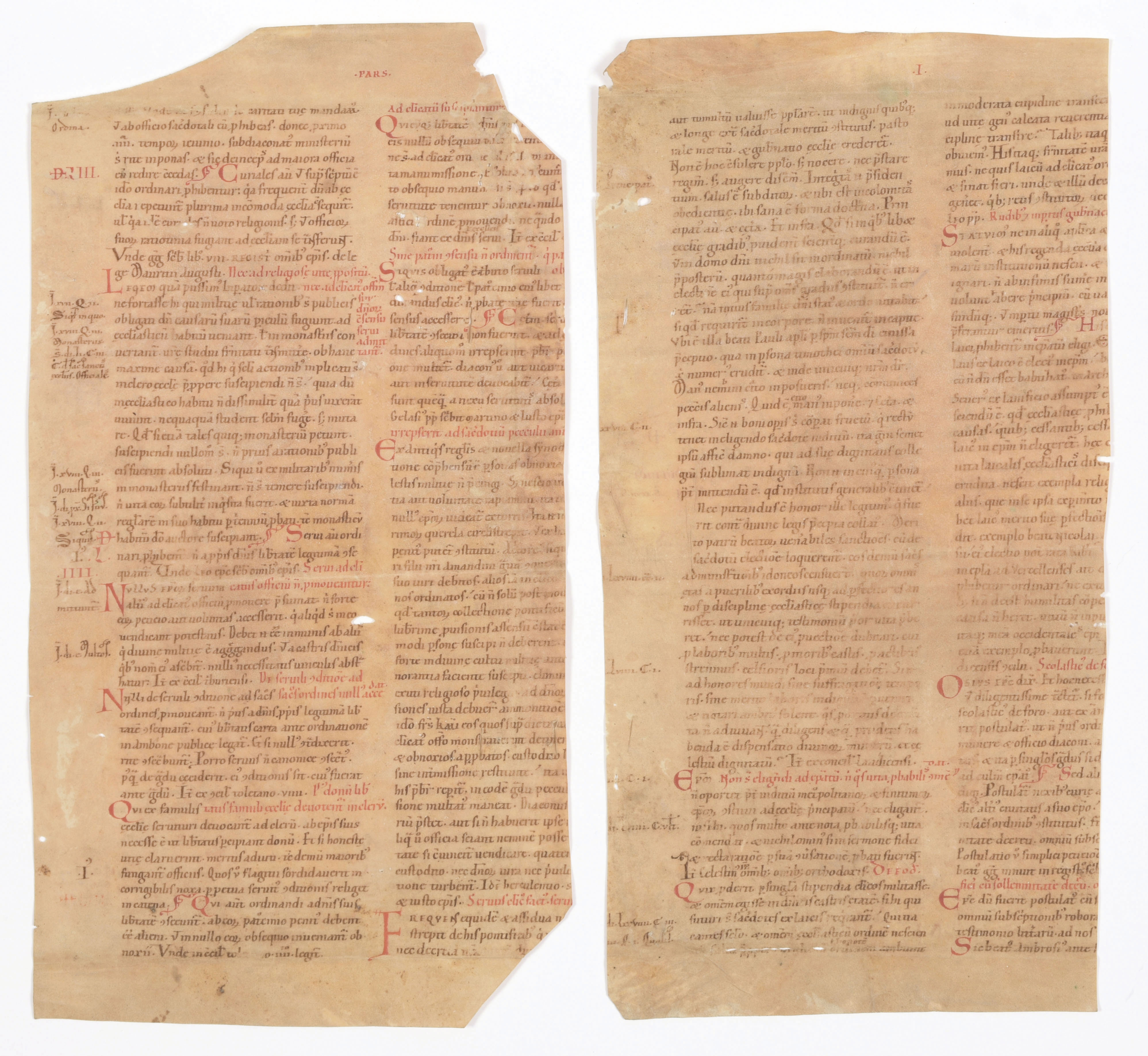
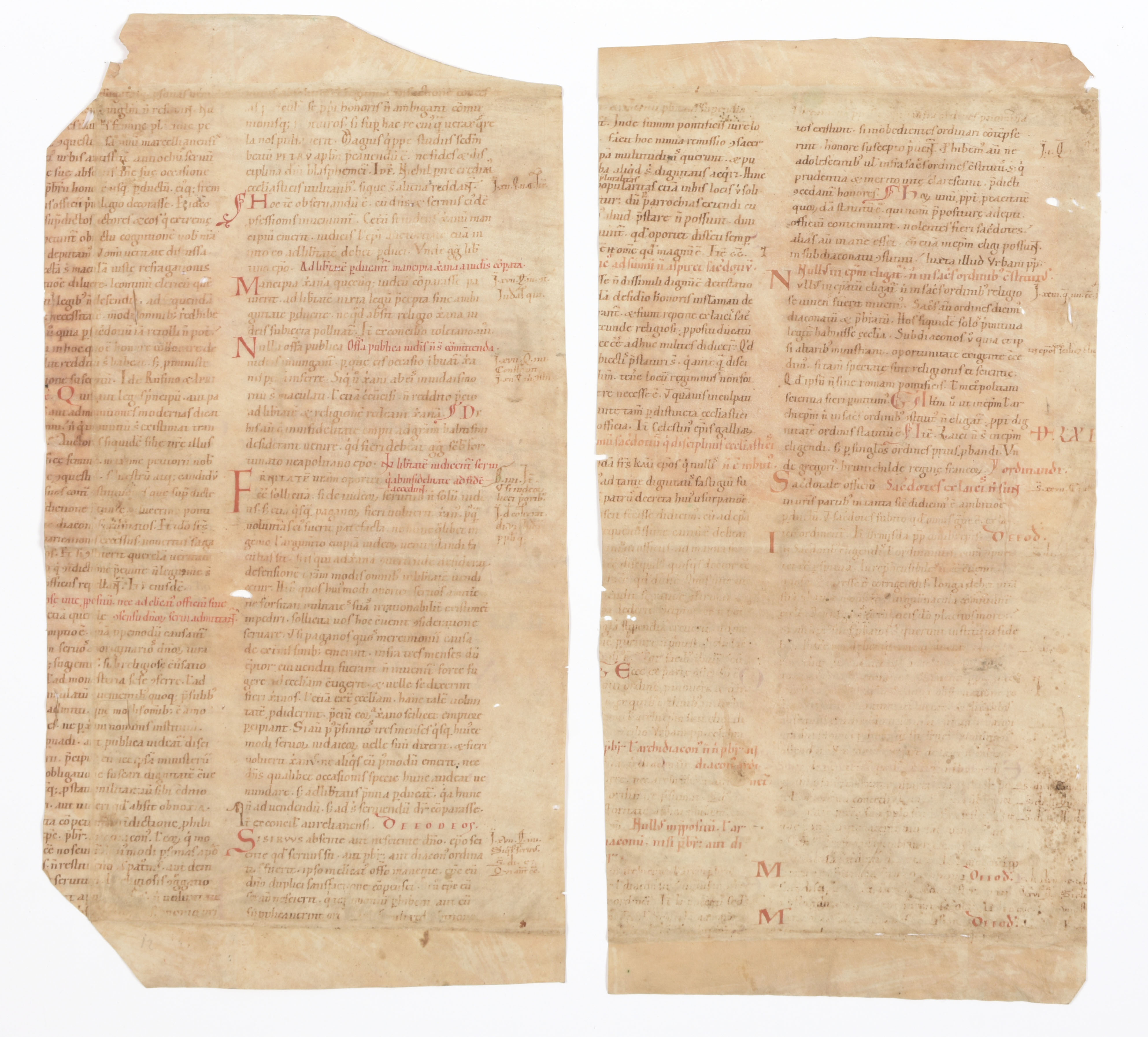
Two leaves, each with edge of one column trimmed away, double column of 53 lines in an accomplished and visually pleasing early Gothic bookhand, with a good st-ligature but no biting curves, red paragraph marks, rubrics, running titles and initials, contemporary marginalia, scuffed in parts on reverse, folds, small holes and losses to edges, overall in good and robust condition, each leaf approximately 368 by 198mm
These are a notably early witness to this important legal text. We know little about the author, apart from his name: Gratian, and that he worked in Bologna. This text was an attempt to resolve discordant parts of the law, with an initial version completed after 1139, followed by a second recension in the 1150s. Once incorporated into the Corpus Juris Canonici it came to form part of the bedrock for all medieval ecclesiastical law, and remained the established text until the early twentieth century. By 1143 the text was in use in legal disputes in Venice, and spread rapidly across the rest of Europe, being cited c. 1180 by Robert of Torigny, the abbot of Mont Saint Michel in Normandy, in his chronicle