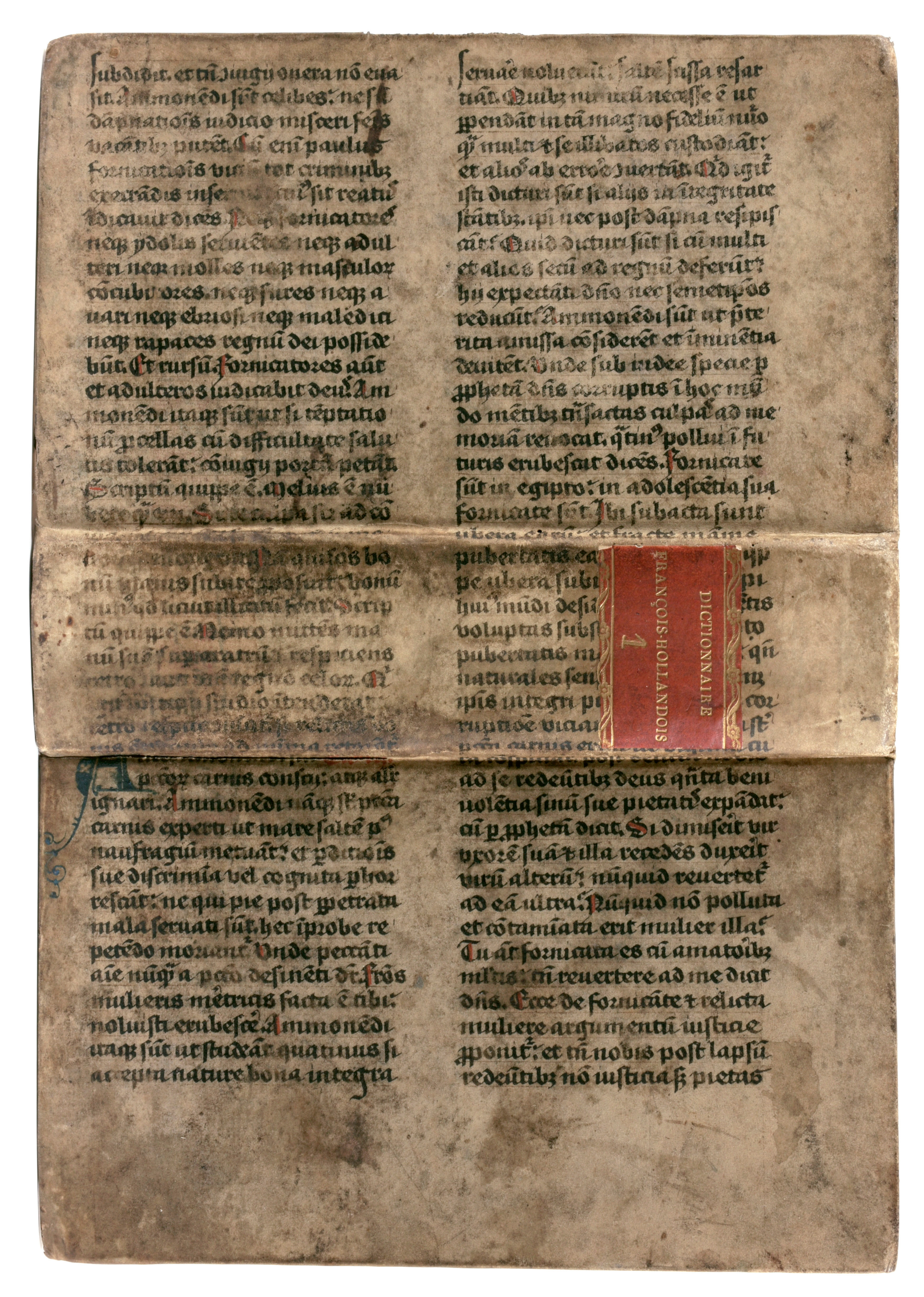
Single leaf, still in situ on a later binding (see below), with text in single column of 43 lines of a squat and low late gothic bookhand, capitals touched in red, one blue initial 'A' with blank vellum designs left in its body (opening what this manuscript claims is chapter 'lii'; in fact midway through same chapter in Migne's edition for Pat. Latina, 77, caput xxvii.'Quomodo admonendi conjugati et caelibes'), still in situ on later binding and hence only one side visible, small spots, stains, scuffs and folds, small splits around spine of later book, else in fair and presentable condition, 280 by 200mm
The present leaf has been used on the binding of a book printed as late as 1835 (Abraham Blusse, Dictionnaire portatif François & Hollandais, printed in Dordrecht, first part only, with 19th-century ex libris stamp of 'Joseph Libert'), and that might suggest an origin in modern Belgium and that the original parent manuscript was one of the innumerable books spilled onto the market from monastic and Cathedral libraries there during the Secularisation in the years around 1800, with many reused as binding material then. The Pastoral Care by Pope Gregory the Great (c. 540-604) is one of the fundamental books of Christian history. Gregory was born in Rome soon after the reconquest of the Eastern Roman Empire from the Ostrogoths, and the need to protect and curate Christendom infuses his works. This text is a lengthy treatise on the intellectual and moral standards that the author saw as responsibilities of the clergy, written around 590 soon after his inauguration, and its translation into Greek was immediately directed by Emperor Maurice as well as distribution throughout his empire (indeed, it was the only patristic work translated into Greek in the author's lifetime). A copy was among the books brought by St. Augustine of Canterbury to Christianise England in 597, and, among other medieval vernaculars, it was translated into Old English in the ninth century under King Alfred's order. Charlemagne's Church reforms held it up as a key guidebook, and Hincmar, archbishop of Rheims in the second half of the ninth century, notes that a copy of the work was given into the hands of bishops before the altar at their consecration. That said, despite being perhaps one of the most common books of the Middle Ages, copies would appear to have been used until they fell to pieces or aggressively collected into institutional libraries centuries ago, and in any form in manuscript it is now rare to find on the market