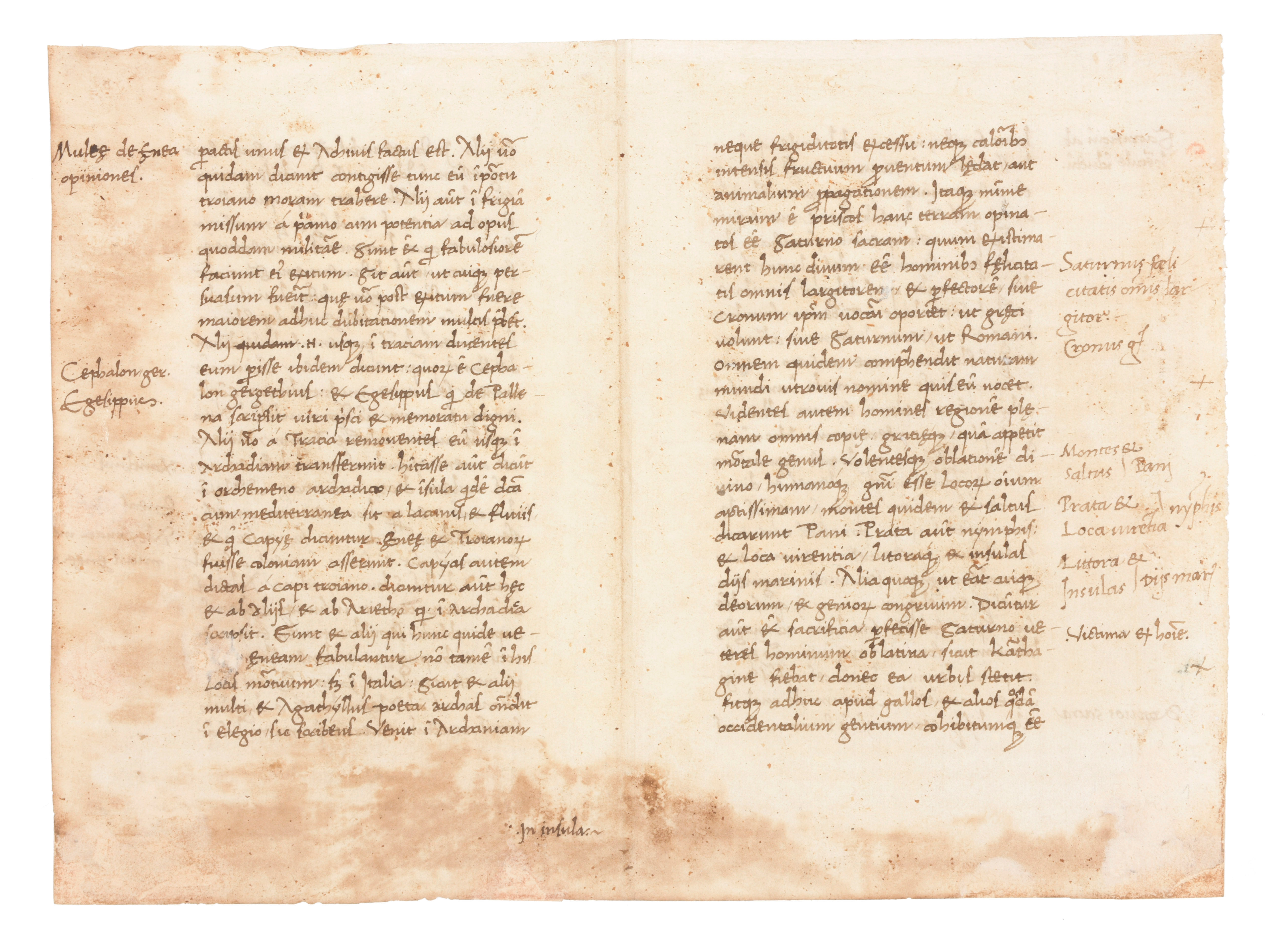
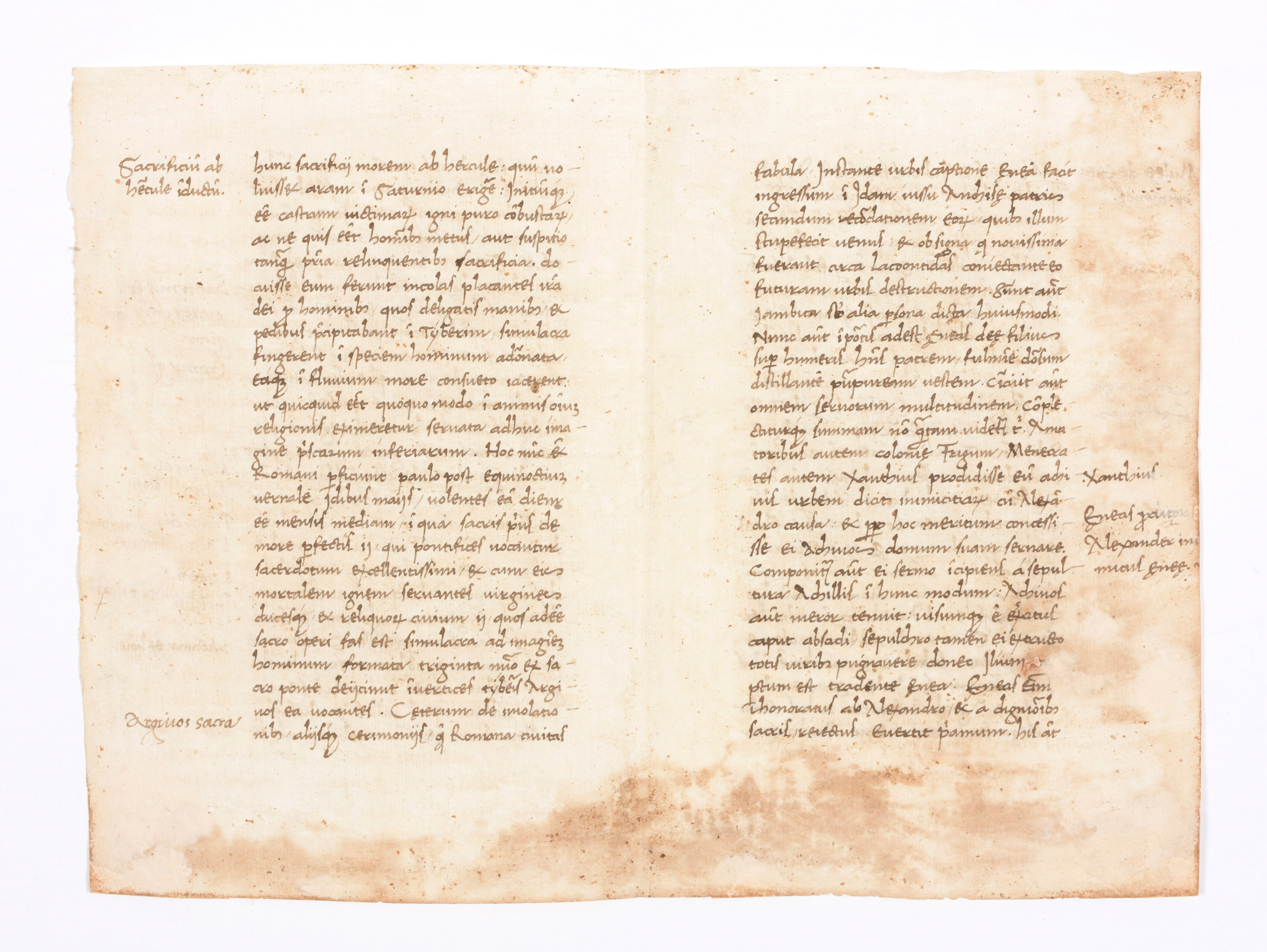
Two conjoined leaves, each leaf: 210 by 145mm, with single column of 25 lines of a semi-humanist hand, names of Classical authors cited in margin in same, last page with a catchword at foot, watermark in middle of central gutter of a gothic 's' with a nodule at its centre and surmounted by a simple cross (close to Briquet nos. 9030-34, all from the first half of the fifteenth century, and near-identical to no. 9056, that recorded in Rome in 1459 and 1461), some small staining to lower and outer edges indicating reuse of this bifolium against the inside of the board of a later binding, small spots and marks, else in good and legible condition
Dionysius of Halicarnassus was a Greek historian, who lived from c. 60 BC. to soon after 7 BC. Early in his life he moved from Greece to Rome where he studied Latin literature and began to collect materials for his grand historical work, surviving there by teaching rhetoric to the children of the Roman elites. The work here in its original Greek, narrates the history of Rome from the mythical period to the beginning of the First Punic War. It organised its material in twenty books - of which only the first ten survive, as well as much of book eleven, with the remainder known only through fragments. The earliest Latin translation was made by Lapus Biragus from two Greek manuscripts supplied by Pope Paul II, and survives in the papal presentation manuscript now Vatican, lat. 1819 (dating to 1469-70), as well as Biragus' printing of the same in Treviso in 1480. The present bifolium is from book one, on the mythical early origins of Rome. While all other manuscripts traced by us of this text are almost certainly copied from the 1480 edition or made to complete a faulty copy of that printed work (excerpts in: Florence, Archivio di Stato, Acq. e Don. 437 and 153 (N III 27), Milan, Bib. Ambrosiana, S 65 sup., Parma, Regia Bib., 1161, Piacenza, Bib. Comunale, Landiani cod. 13, Volterra, Bib. Comunale, 6201 (LVI 6.19) and perhaps Mattsee, Stiftsbibl. Hs. 21; and codices: Vatican, Chigi, J VI 219, J VIII 277, and Valencia, Bib. Univer., 857), the early date of the watermark here and the fact that these leaves are significantly smaller than all recorded incunable versions, suggests that the parent codex descends from the limited manuscript tradition around that produced for Pope Paul II rather than the later printed text. It may even have been prepared for, or by, the translator himself as part of a personal copy or in the preparation of Vatican, lat. 1819