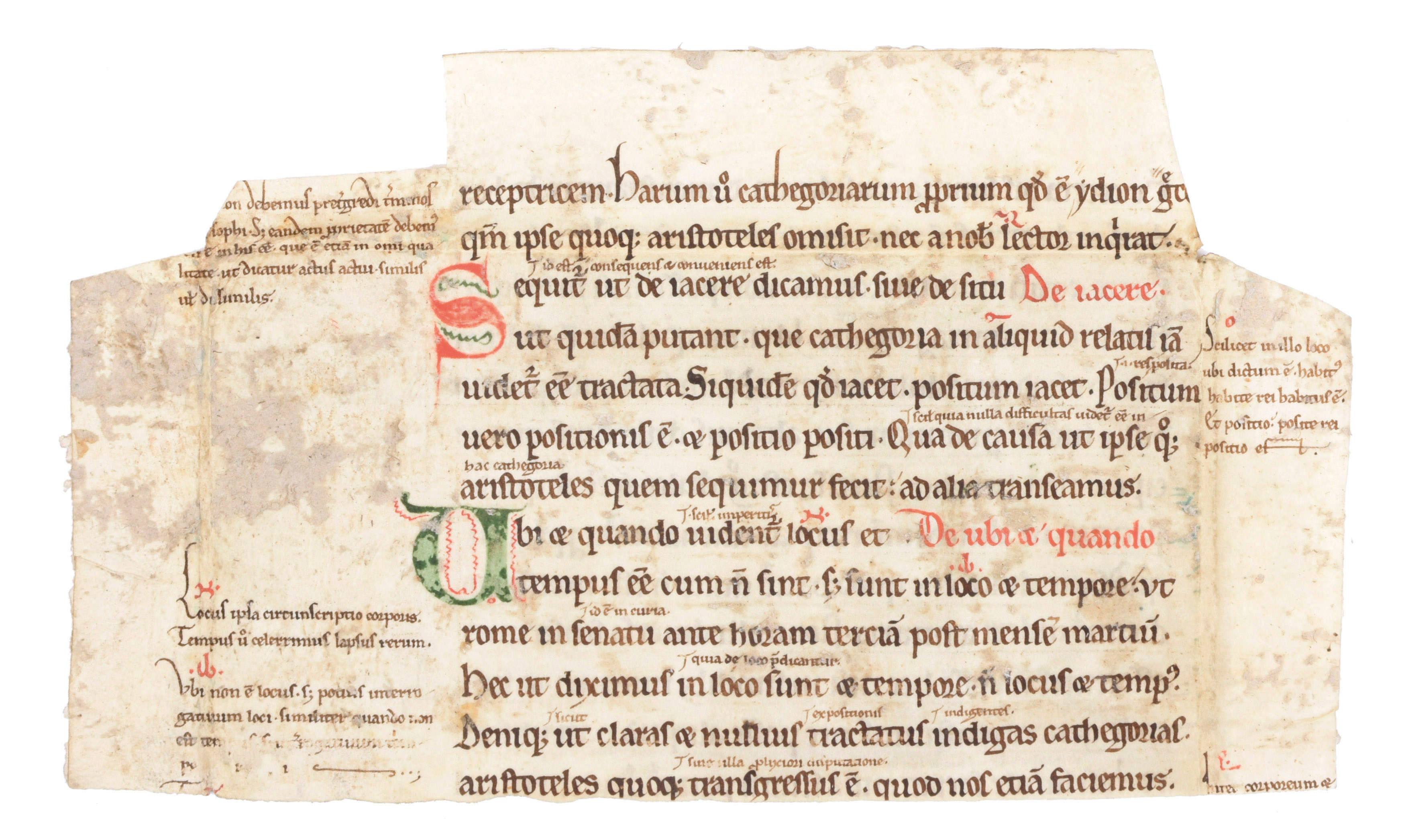
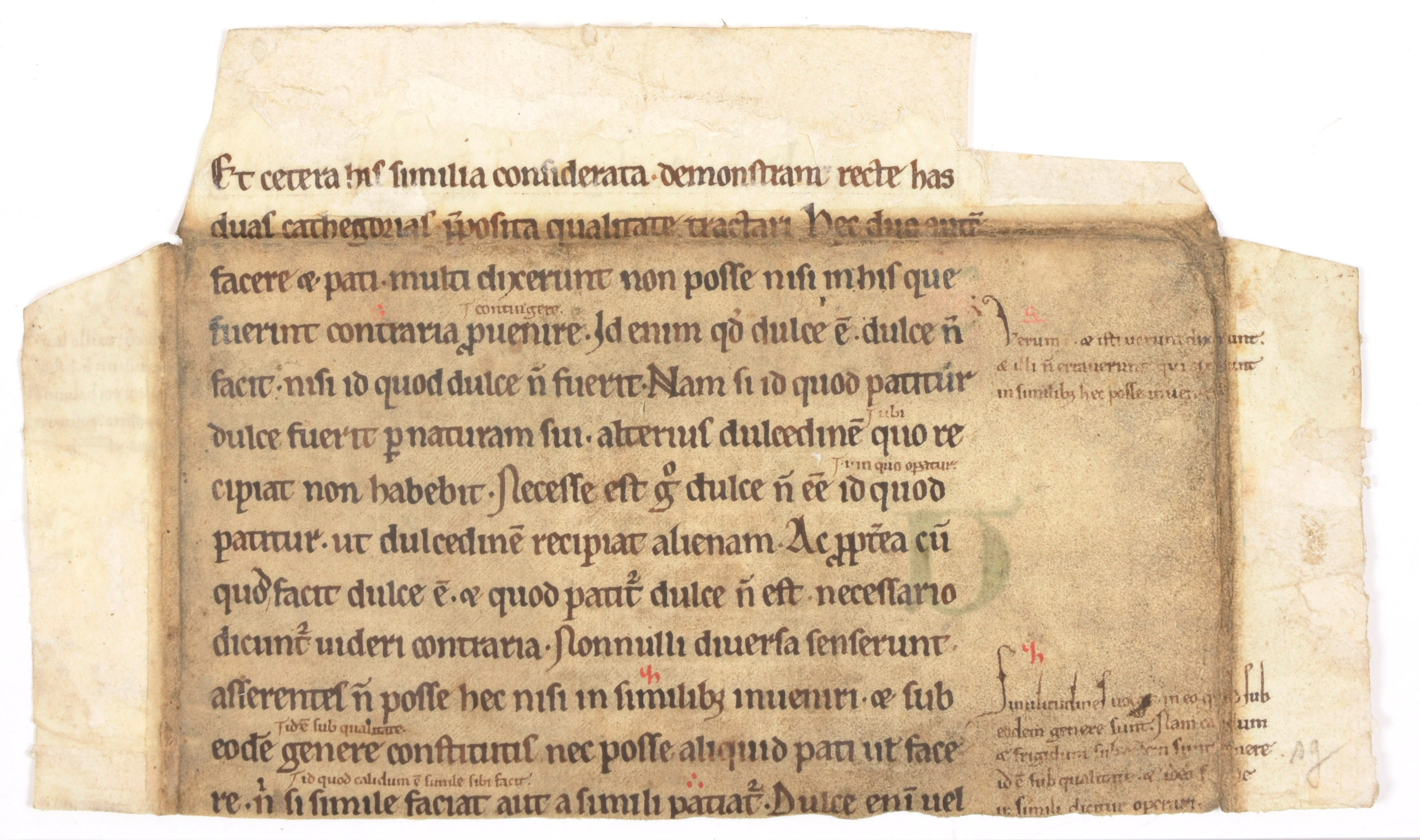
Top half of a leaf, 128 by 217mm, written in single column with remains of 13 lines of a good and professional early gothic bookhand, numerous interlinear glosses in tiny contemporary hand, red rubrics and insertion marks for the gloss of Heiric of Auxerre (see below), with these glosses added to margins in smaller version of same hand, simple red or green initials decorated with jagged penwork in contrasting colour, recovered from a binding and hence with corners clipped away, some stains, darkening and small amounts of paper adhering, overall in good and legible condition
This is a remarkably early witness to the study of Aristotle in the West. Themistius (317-388 CE.) was a Greek statesman, rhetorician and philosopher, who flourished at the imperial court despite the fact that he was not Christian, finally serving as prefect of Constantinople in 384. Photius records that he wrote commentaries in Greek on all of Aristotle's works, and the Suda notes his epitomes of the Physics, the Prior Analytics, Posterior Analytics, On the Soul and the Categories. The Latin translation of this work (as here), usually known as the Categoriae decem, most probably dates to the late fourth century, and from the eighth century became one of the main sources for the teaching of logic in Western Europe. The ninth century saw the addition of an extensive gloss by Heiric of Auxerre (841-876), and the surviving manuscripts suggest that for the ninth and tenth centuries this Latin text eclipsed even Boethius' translations of Aristotle's works, and influenced the works of Alcuin, Fridugisus and Johannes Scotus. In the Middle Ages it was falsely attributed to St. Augustine, but was slowly made redundant by the new translations of the text that appeared in the twelfth and thirteenth centuries