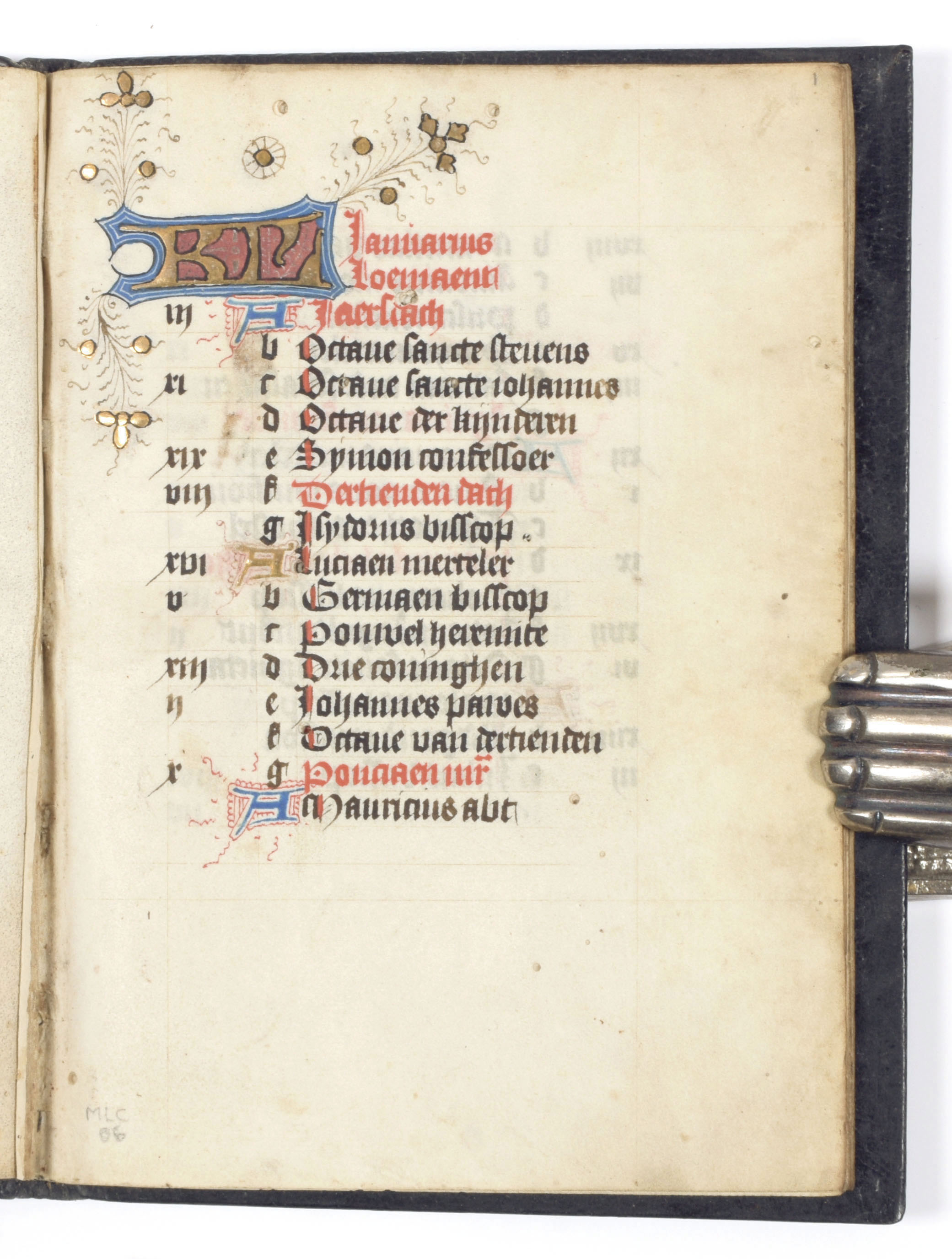
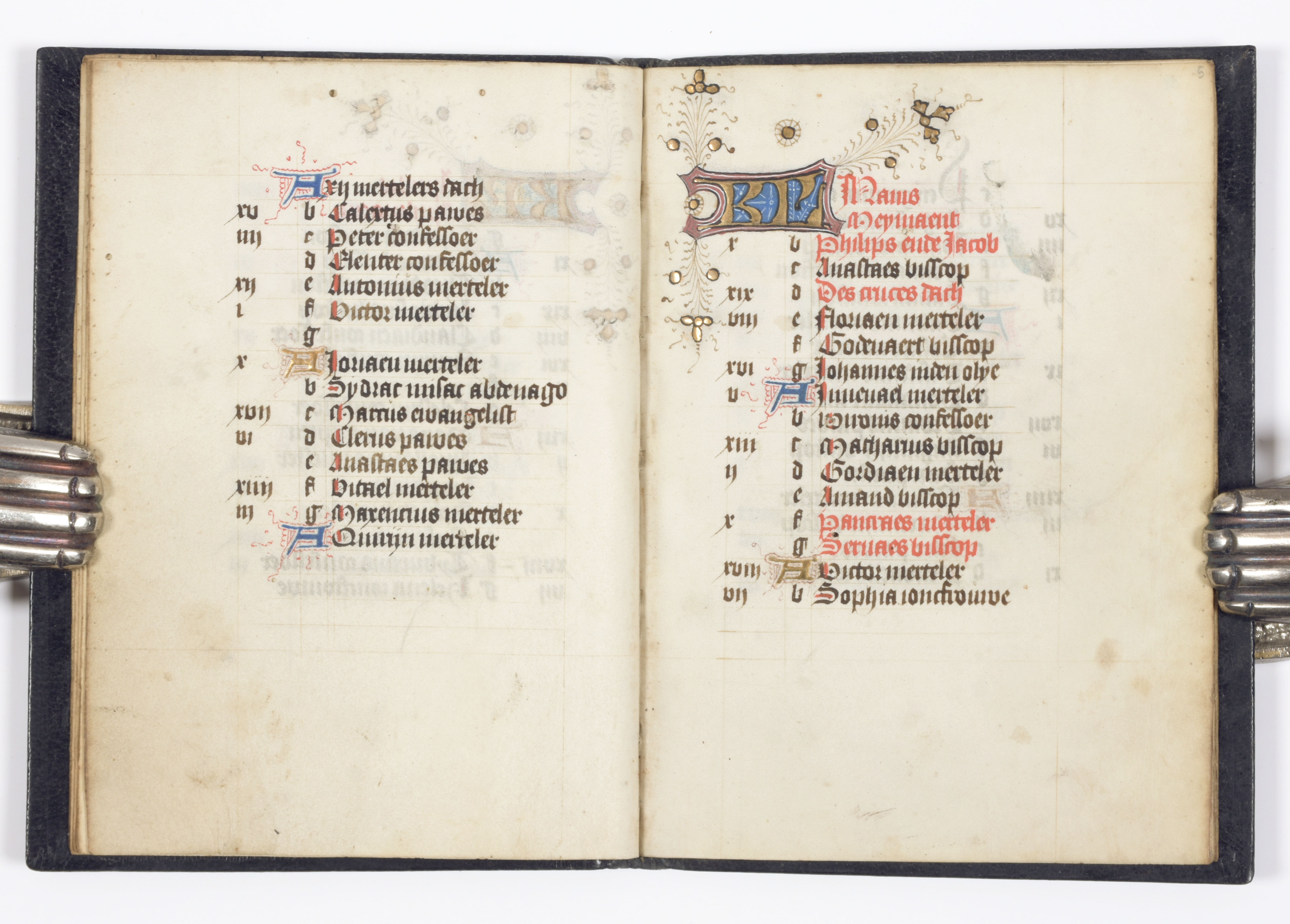
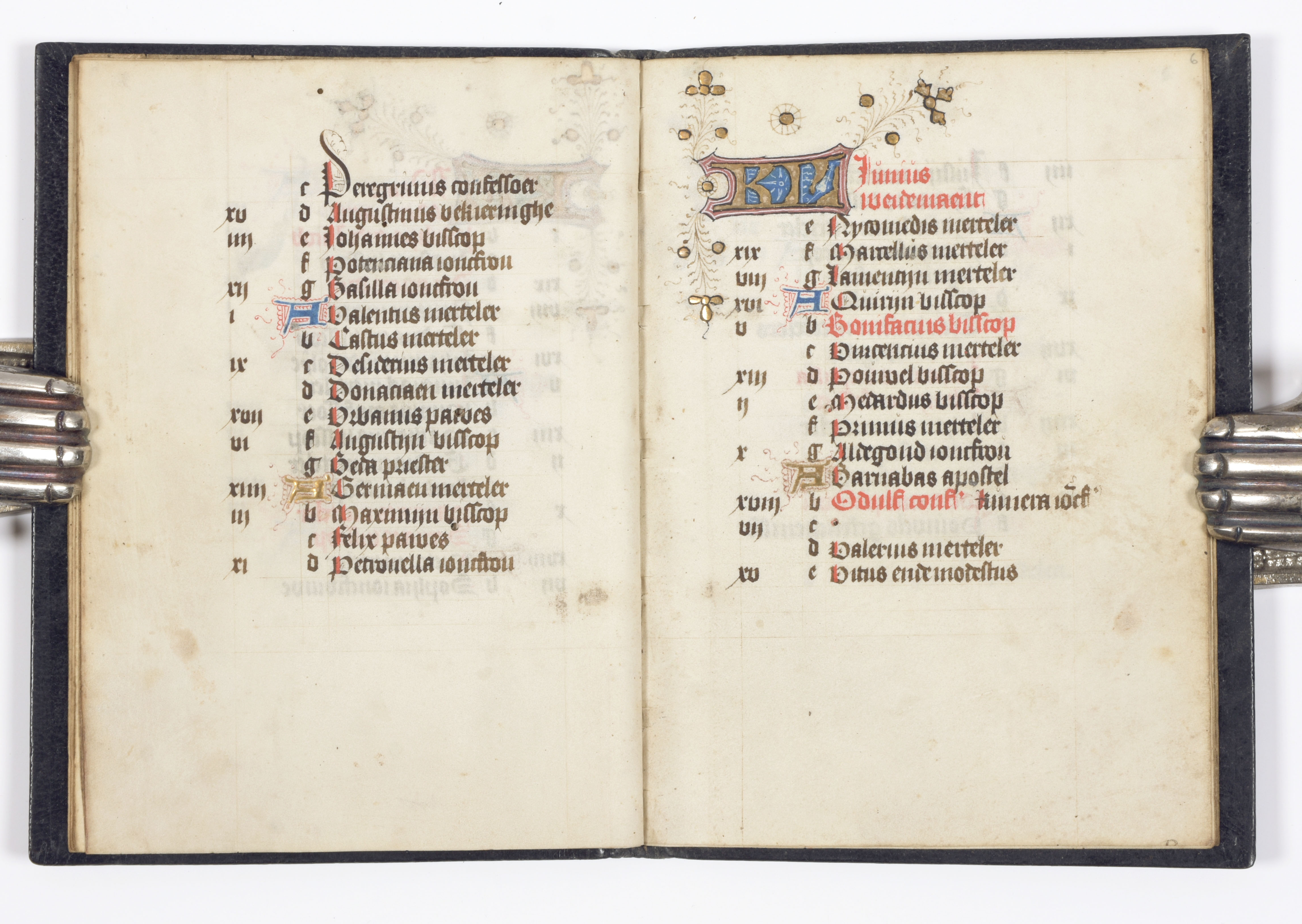
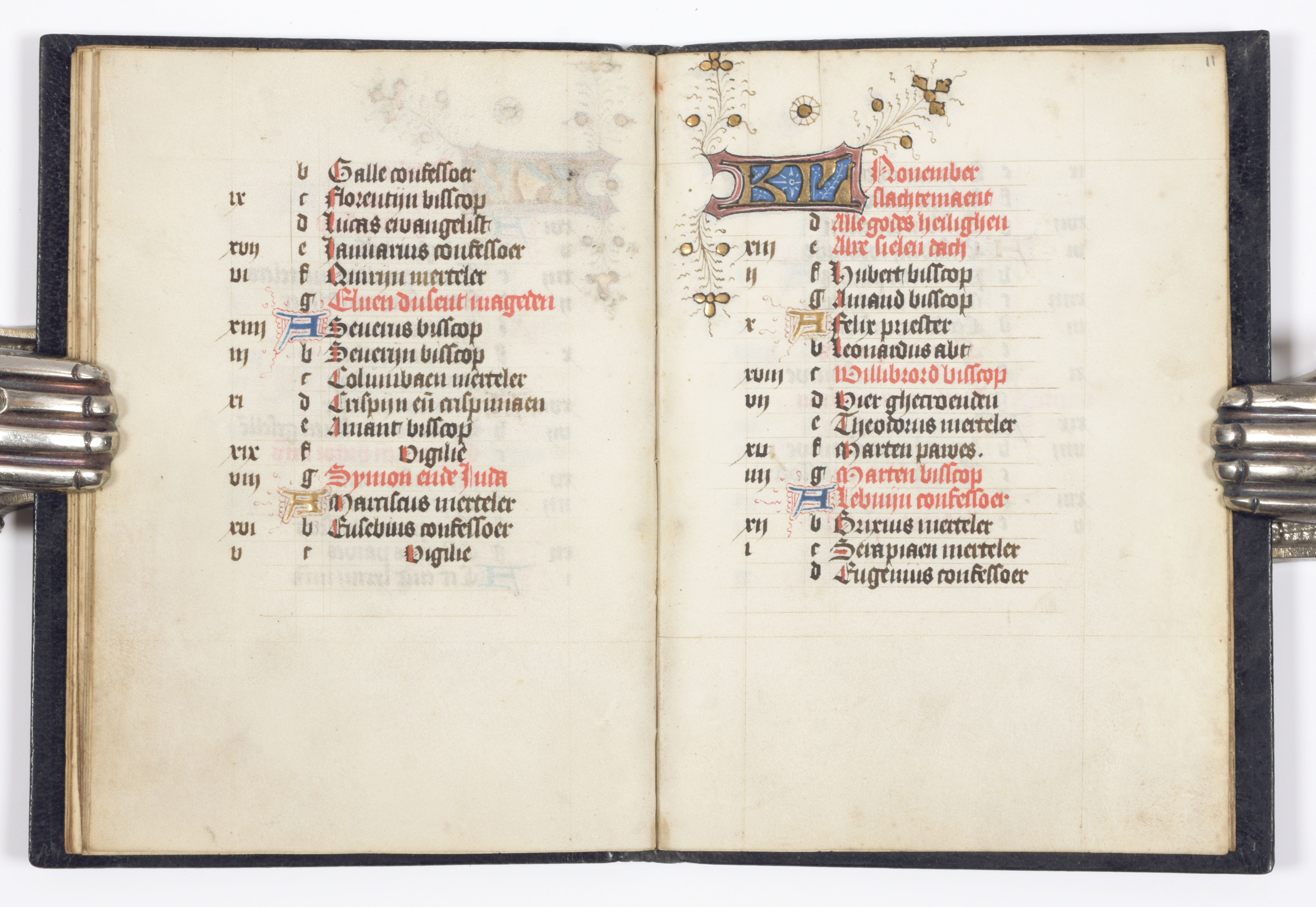
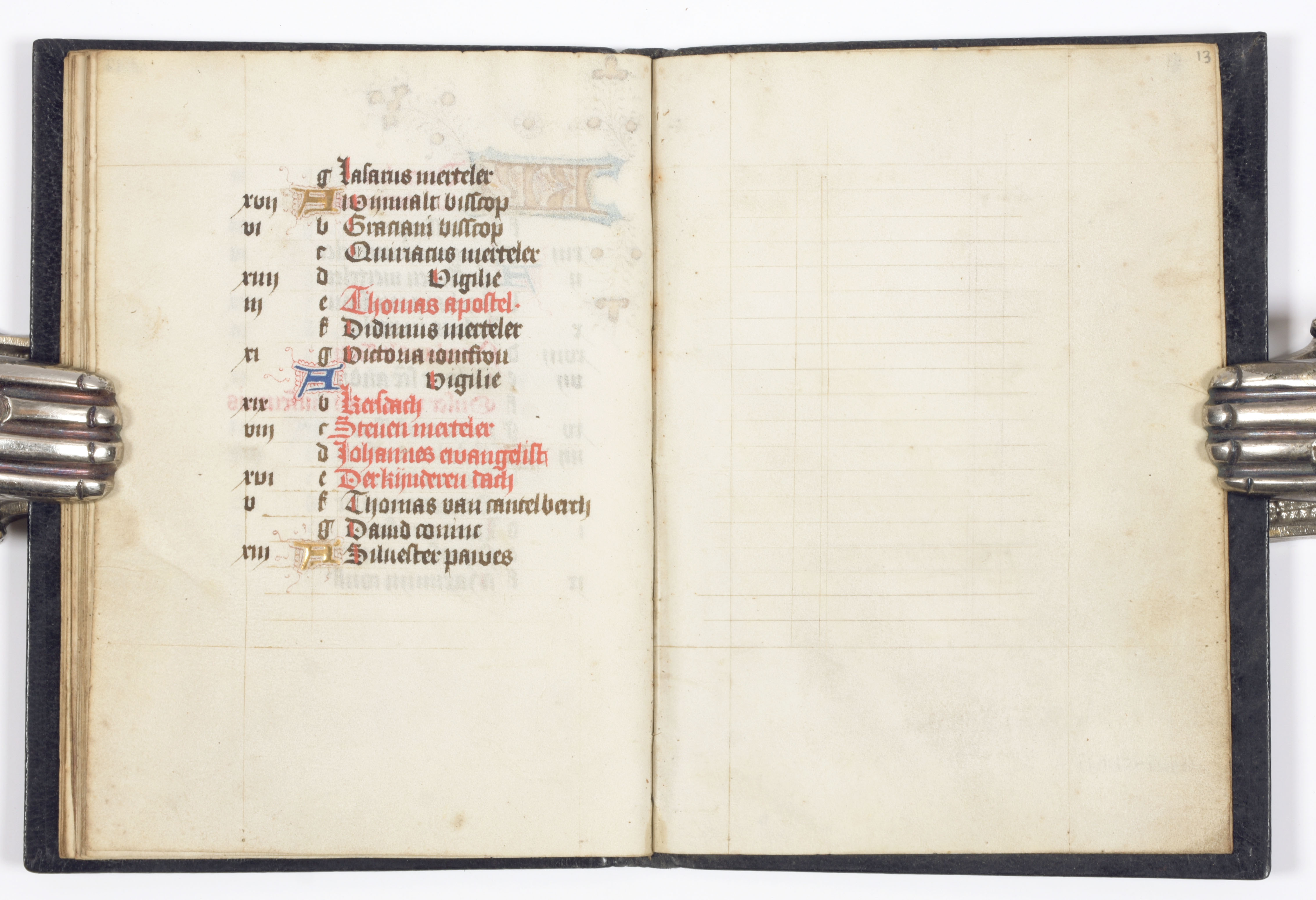
15 leaves (including one original endleaf at front, and 2 at back; the rest in two quires of 6 leaves each), text continuous, entries for months in single column of an angular vernacular late-Gothic bookhand, ruled for 19 lines, key feast-days in red, capitals touched in red, one-line initials in blue or liquid gold with red or dark pink penwork, 'KL' initials in gold on blue and dark pink grounds heightened with white penwork and terminating in trilobed gold flowers with gold bezants and flowerheads with gold centres, a few wormholes and slightly trimmed at edges (with only minor affect to illumination in upper margin of some leaves), small spots and stains, overall in excellent condition, 147 by 110mm; in modern binding of black leather over pasteboards, spine with erroneous ""16th Century Manuscript Calendar"" in gilt
The physical dimensions and distinctive floral sprays and flowerheads of this manuscript allow us to identify it as from the same dispersed Book of Hours listed by M. Manion, V.F. Vines and C. de Hamel, Medieval and Renaissance Manuscripts in New Zealand Collections (London, 1989), p. 100 (no. 87; there cataloguing Dunedin Public Library, RMM Fragment 24). Two single leaves (one with a historiated initial enabling the identification of the artists as the Masters of Zweder van Culemborg) were sold in Christie's online auction, 3 December 2015, lot 30. The book was broken by Folio Fine Art in the 1960s, with leaves initially in their catalogues 27, no. 124, 33, no. 103, 194, no. 66, among others (misdescribed as 'Use of Cologne'), and the present leaves were also acquired from them by the late Professor Marvin Colker in 1965 (his 'MLC 6'). It is fortunate that the late Professor Colker acquired the whole Calendar, as earlier speculations about the origin of the book in Utrecht can now be given support and have greater detail added to them. In particular, the inclusion of St. Odulf, an Anglo-Saxon missionary to Frisia, then later canon of Utrecht, in red for 18 June, consolidates the impression that this was an Utrecht production, but the appearance of St. Lebuin, an Anglo-Saxon missionary to Frisia, then buried at the church he constructed in Deventer, in red for both his main feast (12 November) and translation (6 June), might suggest an alternative origin in the vicinity of Deventer. The original patron may also have had links to the region of Tongeren-Maastricht, and St. Servatius (the founder of that see) appears in red for 13 May