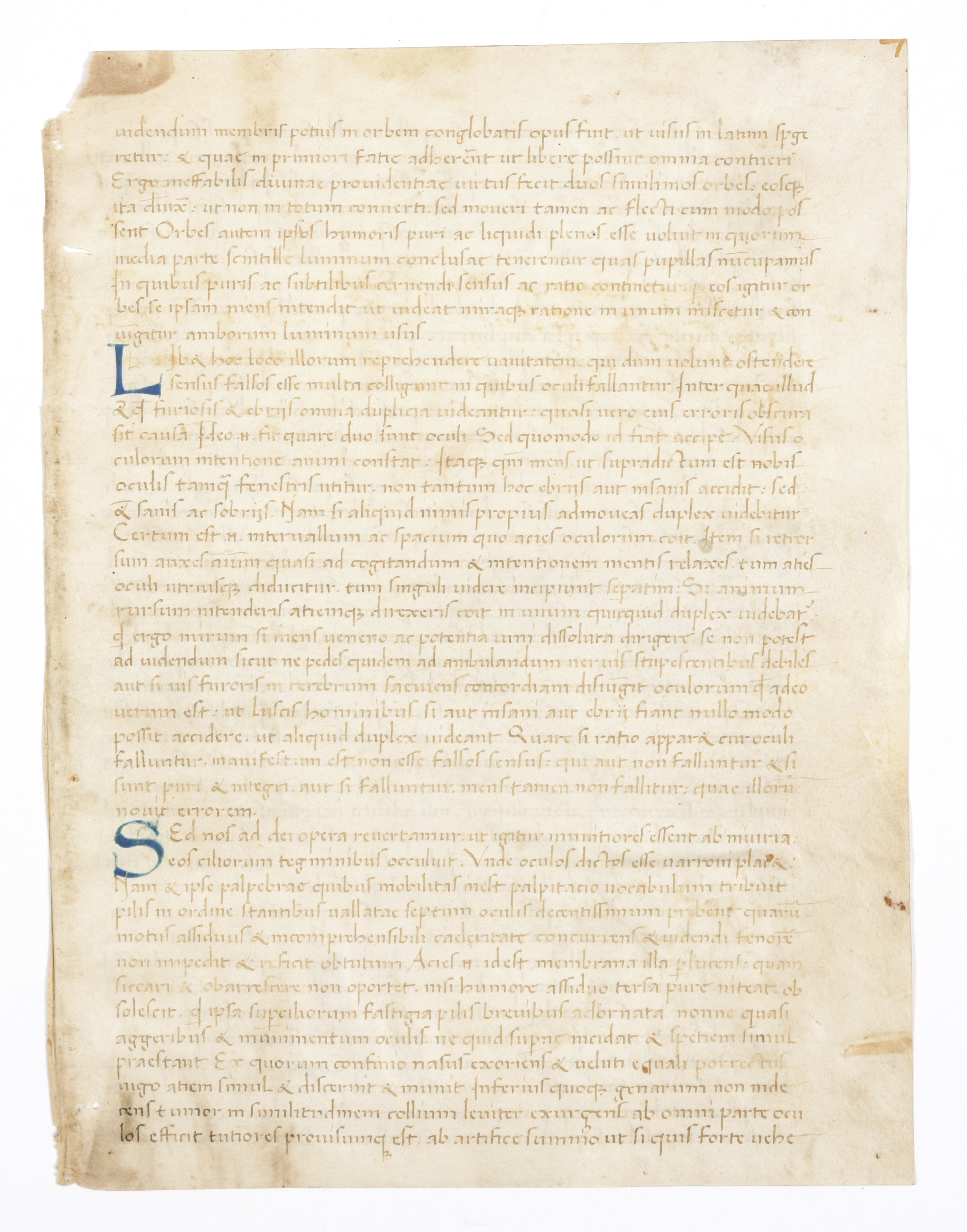
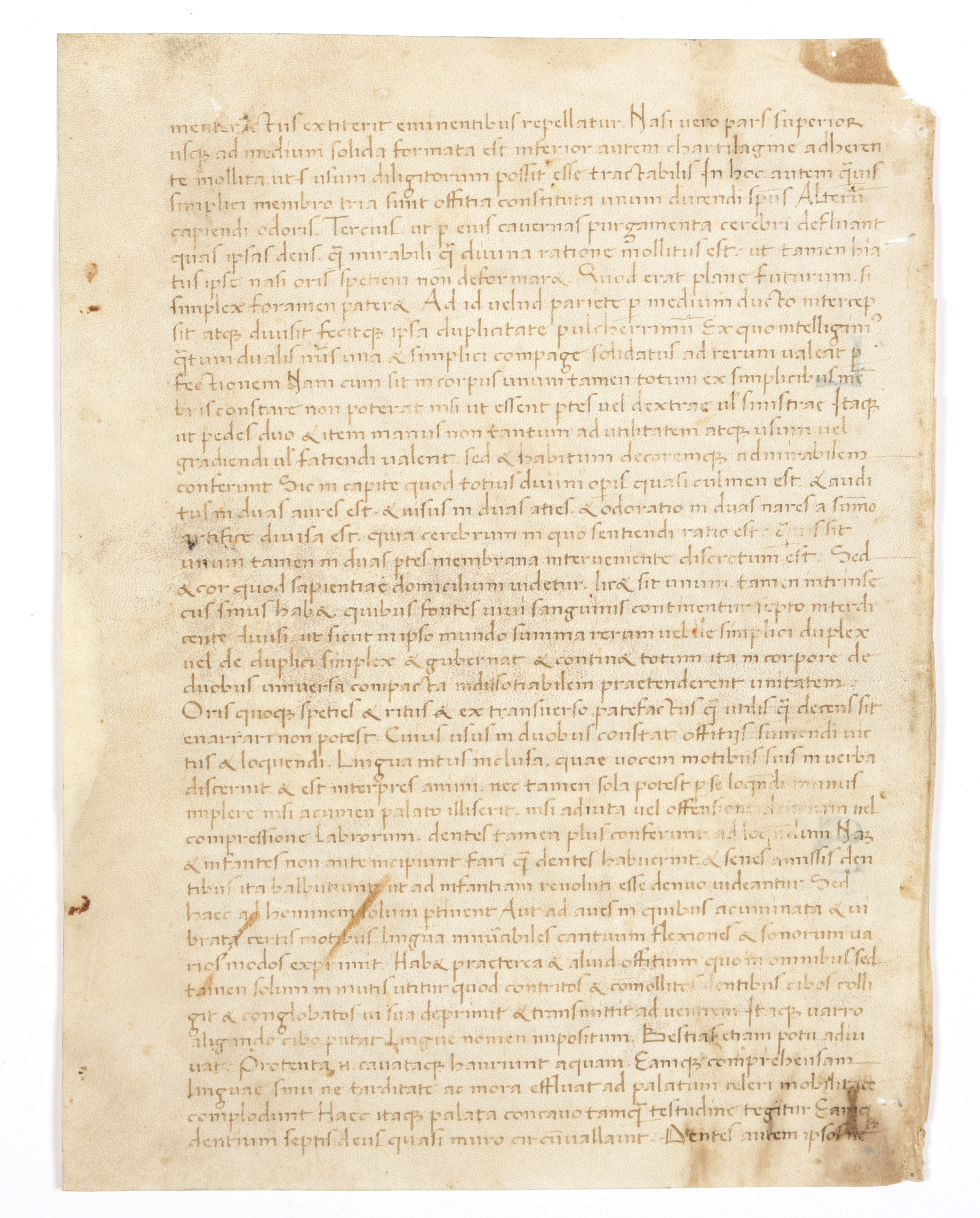
Single leaf, with text in single column of 41 lines of a delicate humanist minuscule, with use of 'et' ligature integrally within the ends of words perhaps suggesting a Carolingian exemplar, 2-line initials in blue, stains to edges, upper inner corner of blank margin torn away, some spots and stains, else in good condition, 265 by 200mm
Lactantius (c.?250-c.?325) stands among the most important early Christian authors. He was of pagan Punic or Berber origin, and studied and then taught rhetoric, firstly in North Africa and then Nicomedia in Anatolia. He converted to Christianity and lived in poverty until he came to the notice of Emperor Constantine I, who he then served as advisor, and following that as private tutor to the emperor's son, Crispus. The early humanists were drawn to his eloquent Latin composition style, dubbing him a 'Christian Cicero'. Thus, the parent manuscript of this text was copied in grand size, but with a homespun simplicity befitting a scholarly humanist reader. The present work was written in 303 or 304 during Diocletian's persecution, and was dedicated to a wealthy former pupil and fellow convert, Demetrianius. The text here comes from the section of the work on the human body, and contains the end of ch. 8 on the parts of man, specifically his eyes and ears, ch. 9, on the senses and their power, and much of ch. 10, on the limbs of man, and their use