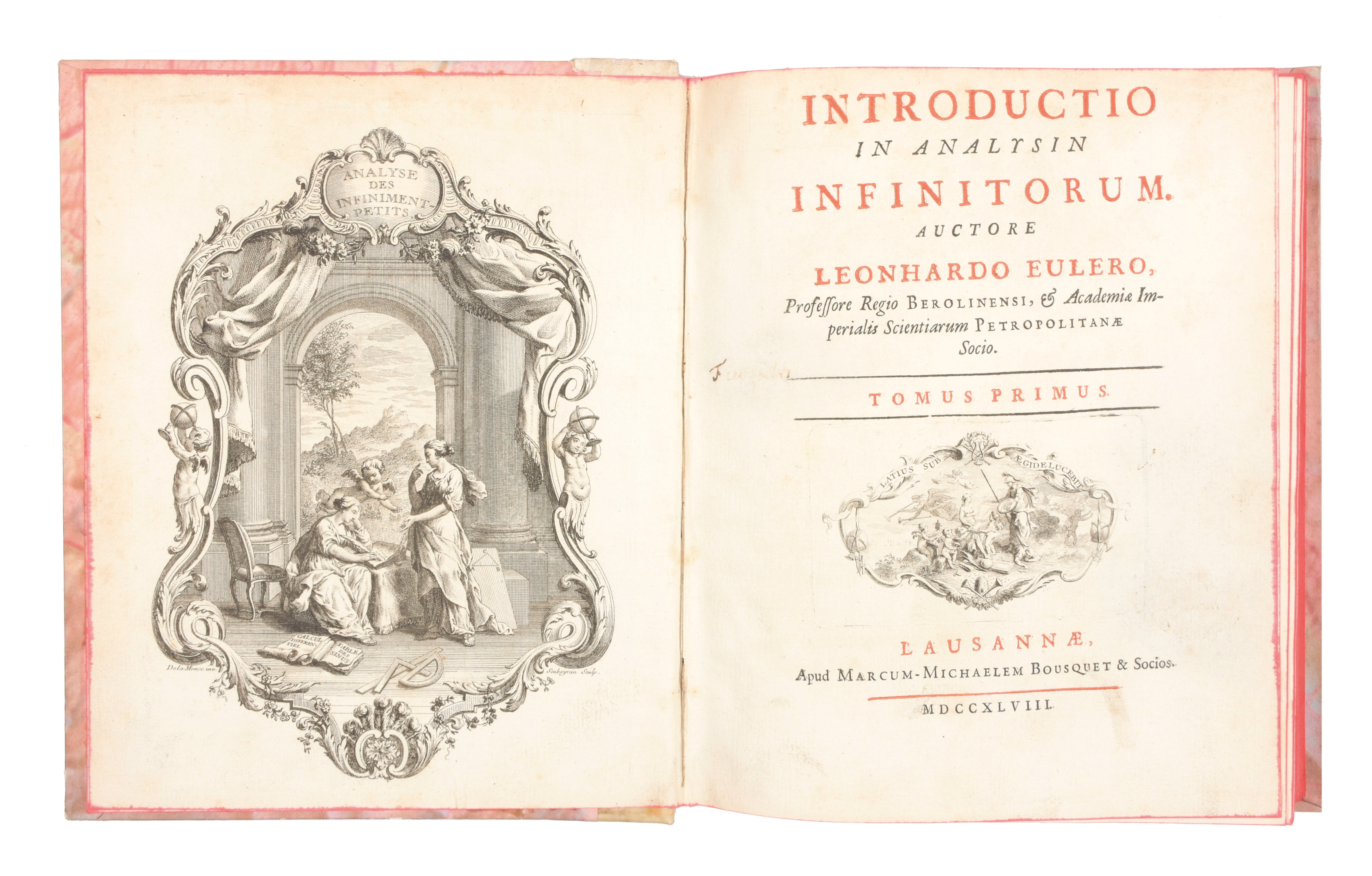
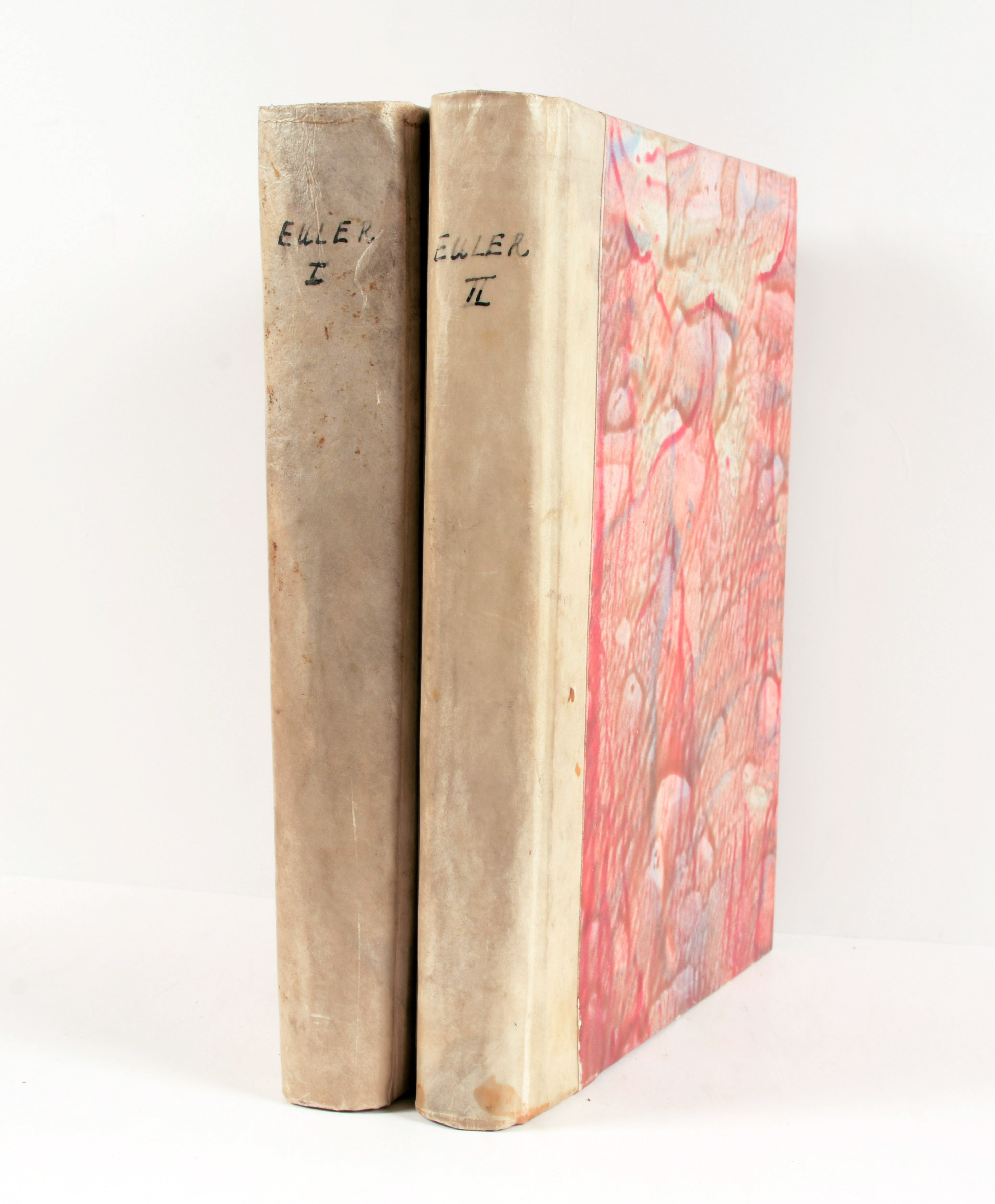
2 vol. in-4to, vol. 1: [ii], xvi, 320 pp, with a folding table next to p. 276 and 40 folding engraved plates (numb. I-XL). (spots on pp. 7-11-192-193) Vol. 2: [ii], 398, [2] pp. (spots on pp. 105-115-252-320). Titles in red and black with engraved title vignettes, frontispiece by Soubeyran after De la Monce (Analyse des infinement-petits), initials, head- and tailpieces, chapter vignettes. Lacking the portrait. Slightly age-toned, margin of f. A2 in vol. 2 repaired. Modern half vellum, red edges
First edition. 'In his Introduction to Mathematical Analysis Euler did for modern analysis what Euclid had done for ancient geometry. It contains an exposition of algebra, trigonometry and analytical geometry, both plane and solid, a definition of logarithms as exponents, and important contributions to the theory of equations.' (PMM 196) This definitive work on analytical mathematics caused a revolution in this branch of mathematics, a subjects which had hitherto never been presented in such a general and systematic manner. Euler's work on infinite series culminated in the creation of the theory of definite integrals, known as Eulerian integrals. He further developed the calculus of finite differences, and established the theorem of homogeneous function