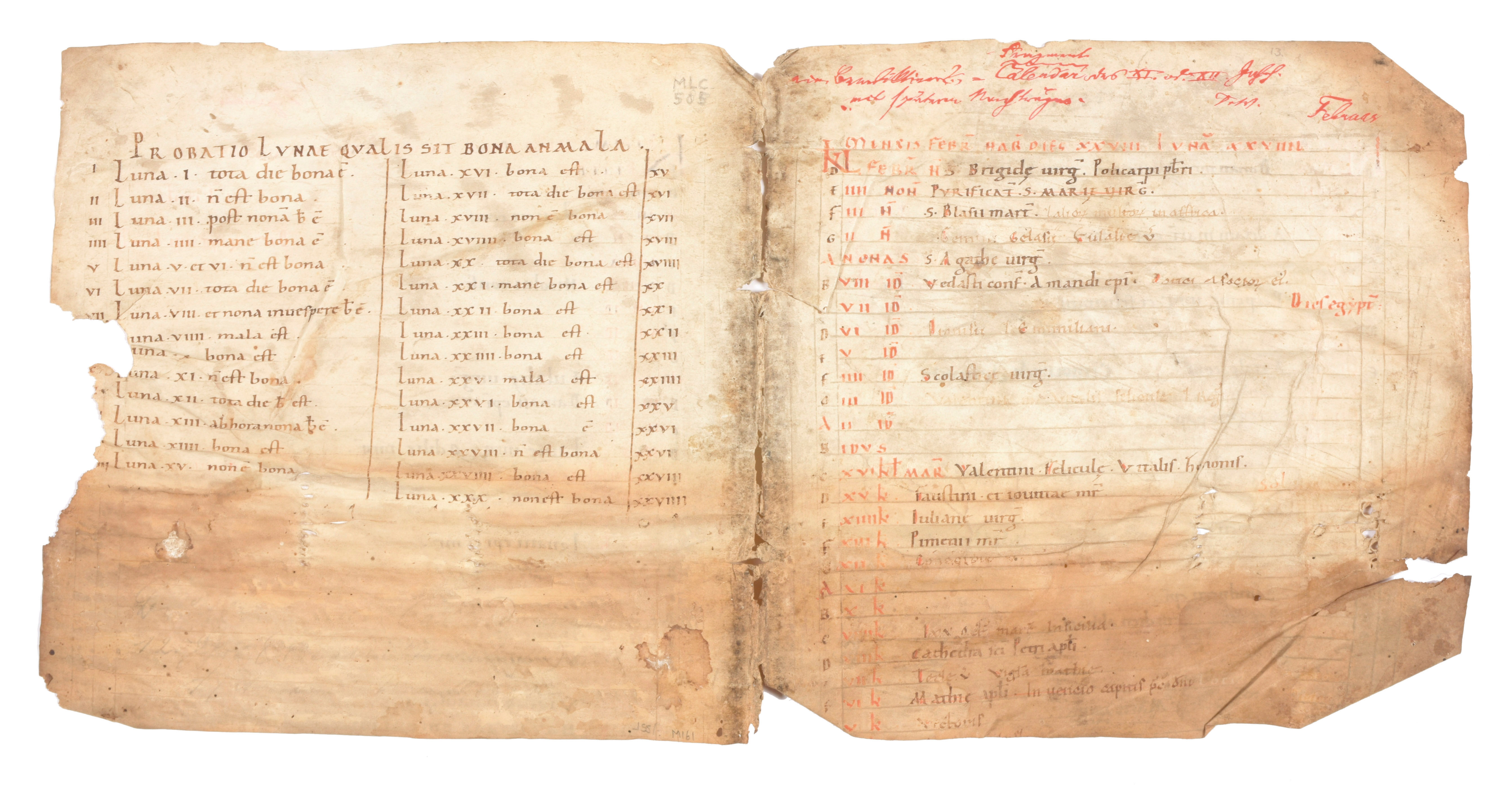
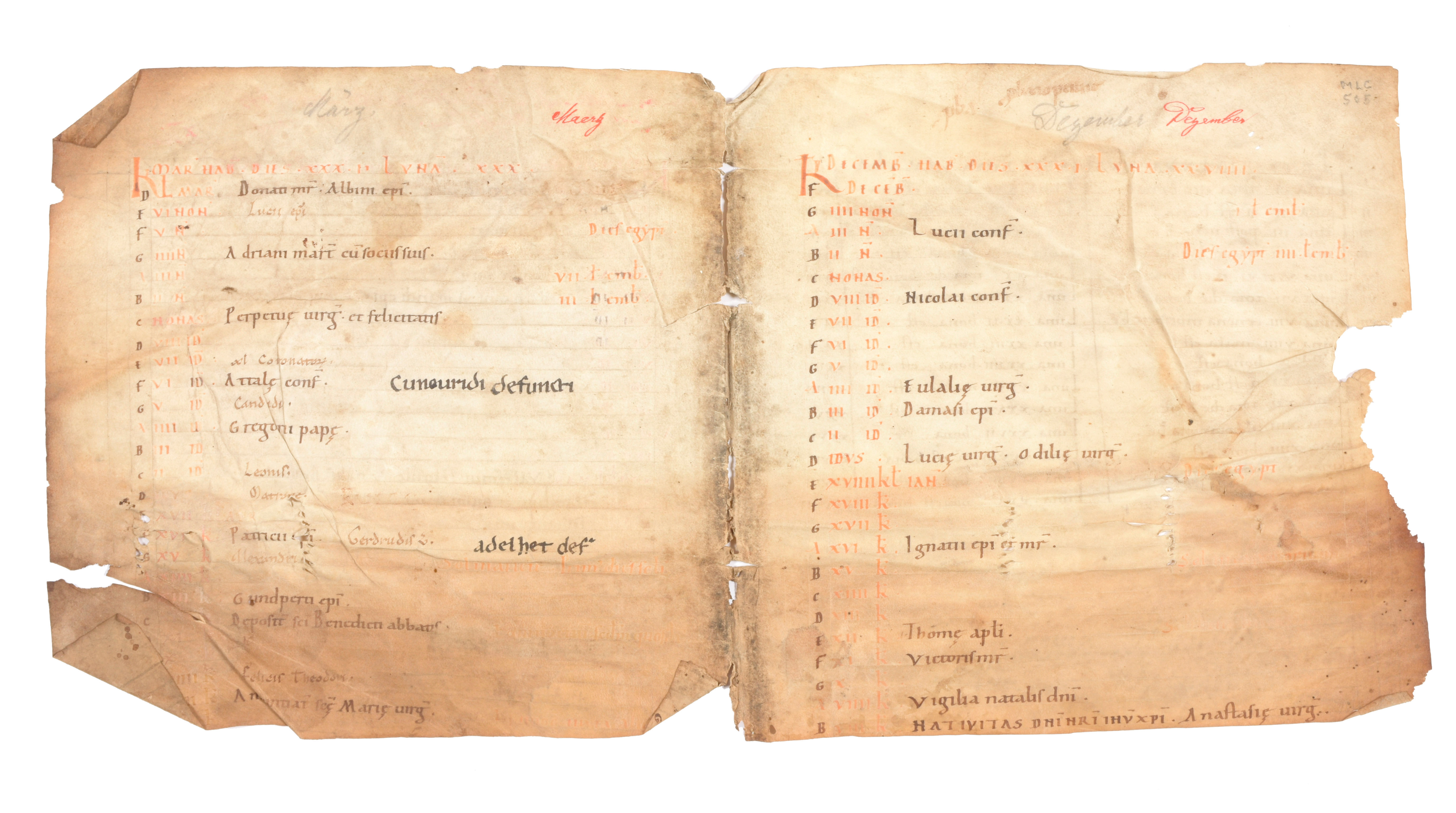
Two conjoined leaves, each leaf: 163 by 168mm, with Calendar entries for February-March and December, plus a table enumerating beneficial days (presumably for blood letting) following the lunar cycle, initial entries in a good Romanesque German bookhand with major feasts marked in ornamental capitals, pale red rubrics and simple red initials, at least four other near-contemporary hands adding additional feasts or notes, nineteenth-century antiquarian notes in German in pencil and pink ink in upper border, recovered from a later binding and hence with stains (notably affecting lower half), small holes, tears and losses at edges and cockling, with lower border and at least one line of text trimmed away, overall fair and legible condition
While there are southern German saints here, such as St. Gumpert of Ansbach (d. 790 with his cult centring on Bavaria; included here on his original feastday of 11 March, that moved to 15 July sometime in the early eleventh century) and St. Odile of Alsace (d. c. 720; 14 December), the presence of more northern saints such as St. Gertrude of Nivelles (d. 659; here an early addition for 17 March), Amand, bishop of Tongeren-Maastricht (main hand for d. 679; 6 February) and St. Vedast, whose cult was promoted in Arras and its vicinity from the seventh century onwards (d. 540; main hand for 6 February), strongly suggests an origin in the region of modern southern Belgium, bordering Germany and Luxembourg. The page for March has two near-contemporary additions: ""Cunouridi defuncti"" and ""adelhet def'"", for which there is no saint known to us. These are most probably the names of dignitaries local to the region the parent manuscript was used in (for similar additions see the bifolium from a Calendar from an eighth-century Sacramentary sold in Sotheby's, 4 December 2007, lot 44)