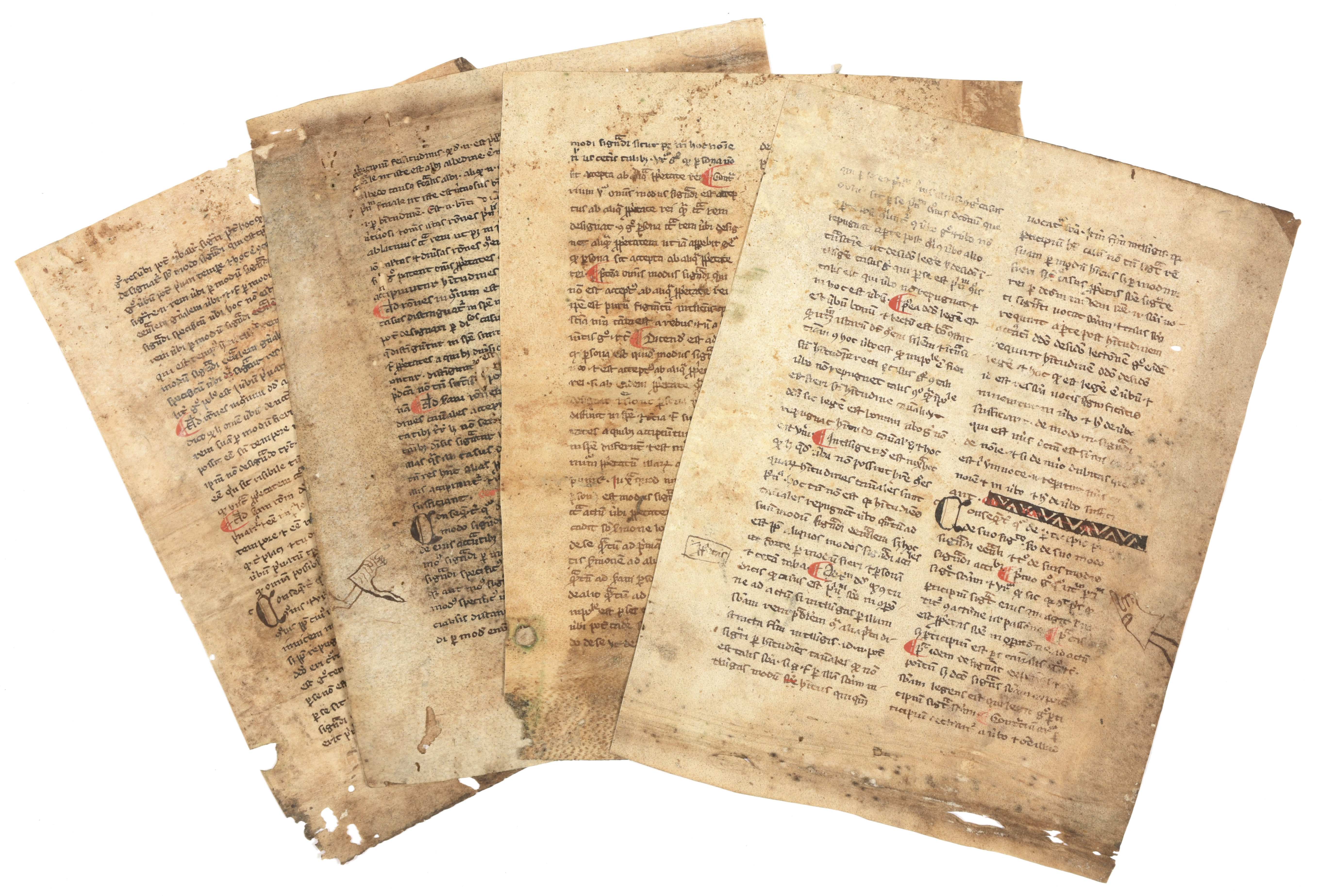
Four leaves, each with text in double column of 34 lines of squat early Gothic bookhand, much abbreviated and showing signs of the influence of university hands, red line-fillers and paraph marks, initials in larger versions of main hand and ink, some later manicula and a clumsy line-filler, stained in places and wormed , but legible, overall in fair condition, each leaf 195 by 147mm
Few medieval Danish authors gained the international reputation of Boetius de Dacia (fl. thirteenth century). The name 'Boetius' was most probably a Latinisation of the Scandinavian name 'Bo', and he was a Danish-born Aristotelian-philosopher and grammarian. He taught philosophy in the University of Paris, where he promoted the Modist's 'speculative grammar' (a northern European movement that saw philosophy as the highest human pursuit, so important that the philosopher should follow it wherever it went, even if that brought him into conflict with religious dogma). He was condemned in 1277 as a leader of the Averroist movement (those who promoted the works of Averroes/ Ibn Rushd, the Arabic commentator of Aristotle's works). He fled Paris and disappeared from history, with one later source naming him among Dominican authors, suggesting that he joined that order and perhaps retired to Denmark to serve as a friar. The present leaves come from a copy of his magnum opus, the Modi significandi sive quaestiones super Priscianum maiorem. The text is far from common. The modern editors record only six extant copies of the work from the thirteenth century, and five from the fourteenth century - all in European institutional ownership (see Jan Pinborg and Heinrich Roos, Modi Significandi sive quaestiones super Priscianum maiorem, 1969, pp. ix-xv). The vast Schoenberg database shows no copies as ever recorded for sale, and this may well be the first time that that any manuscript of the work has appeared on the market