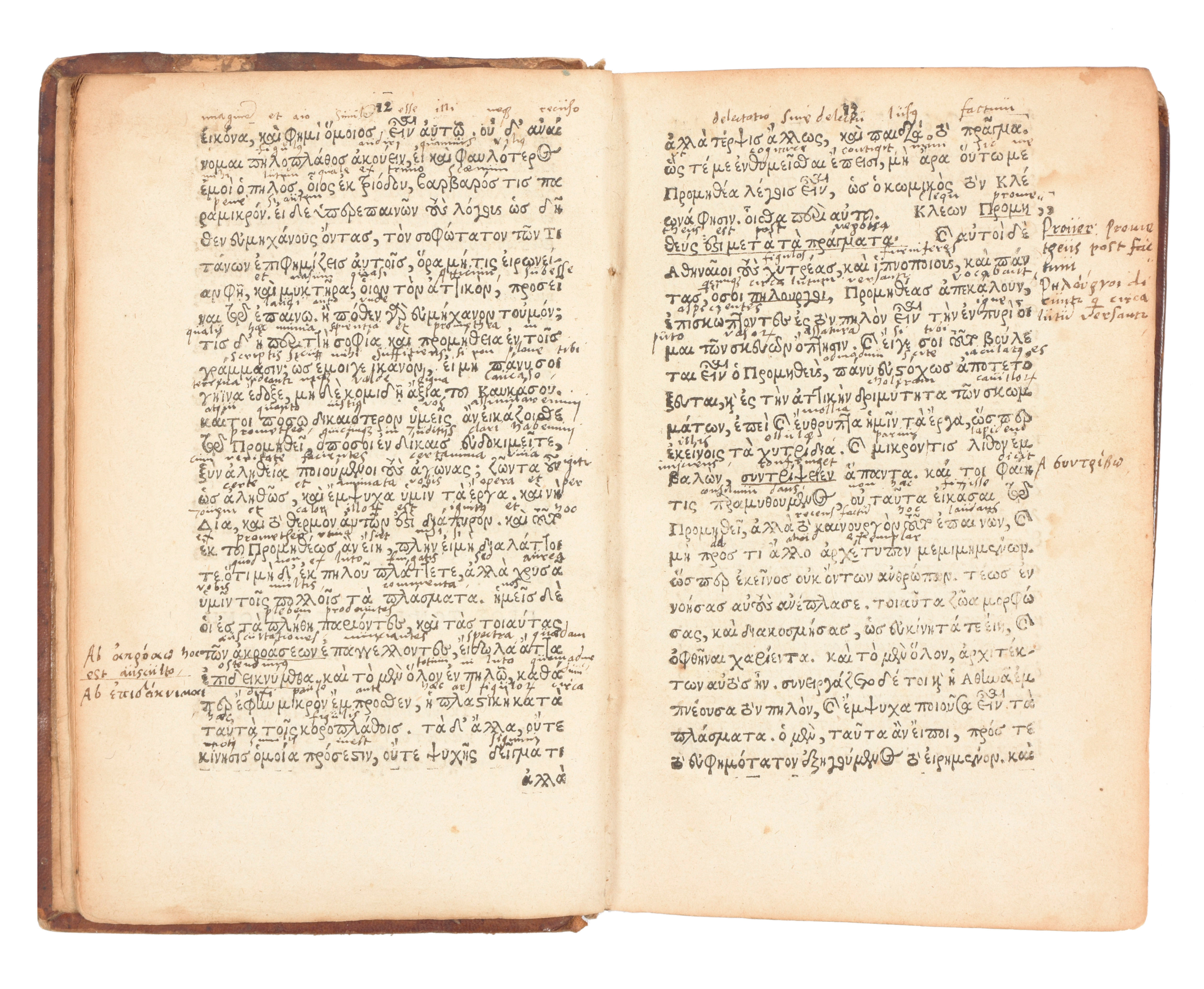
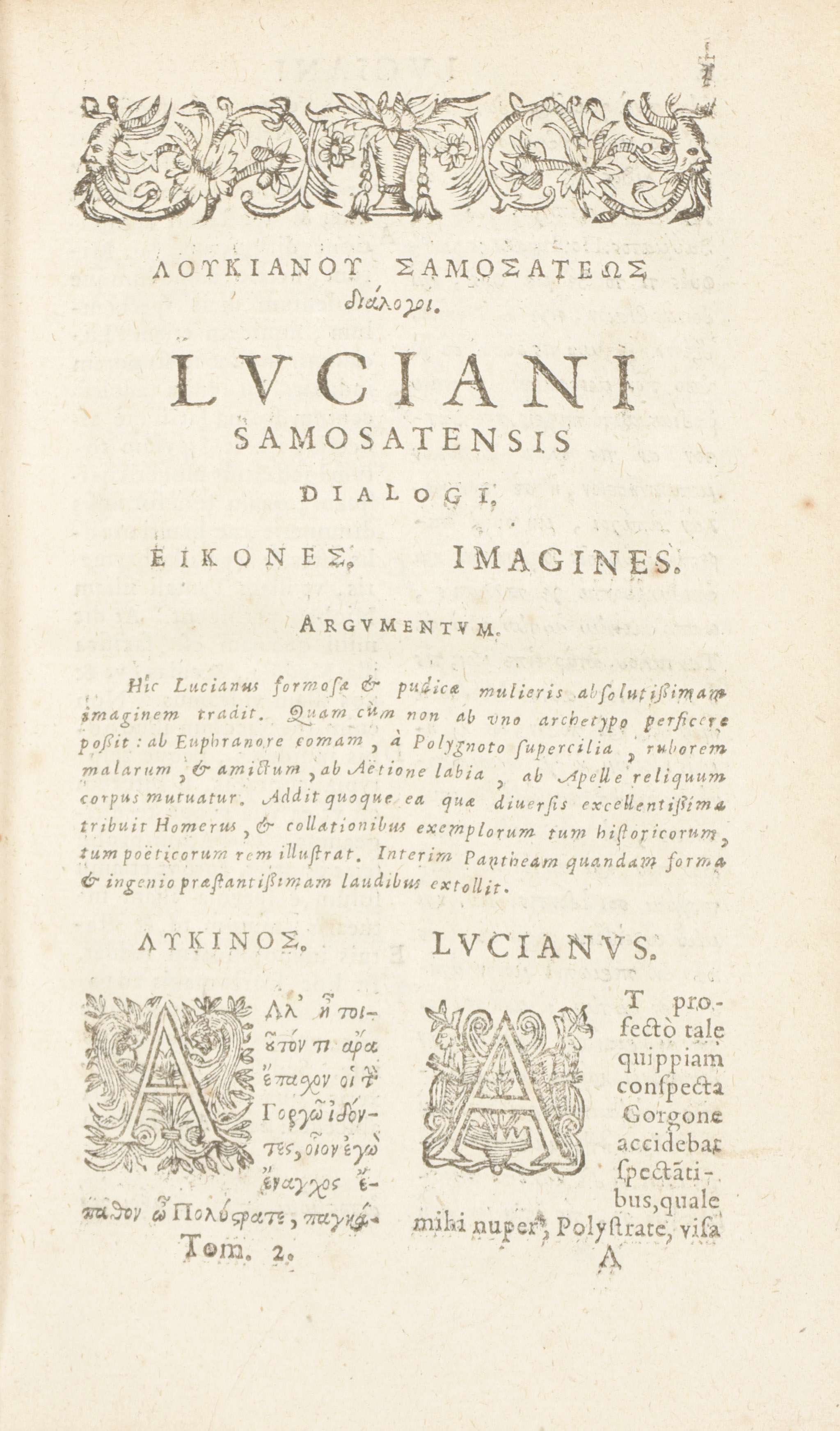
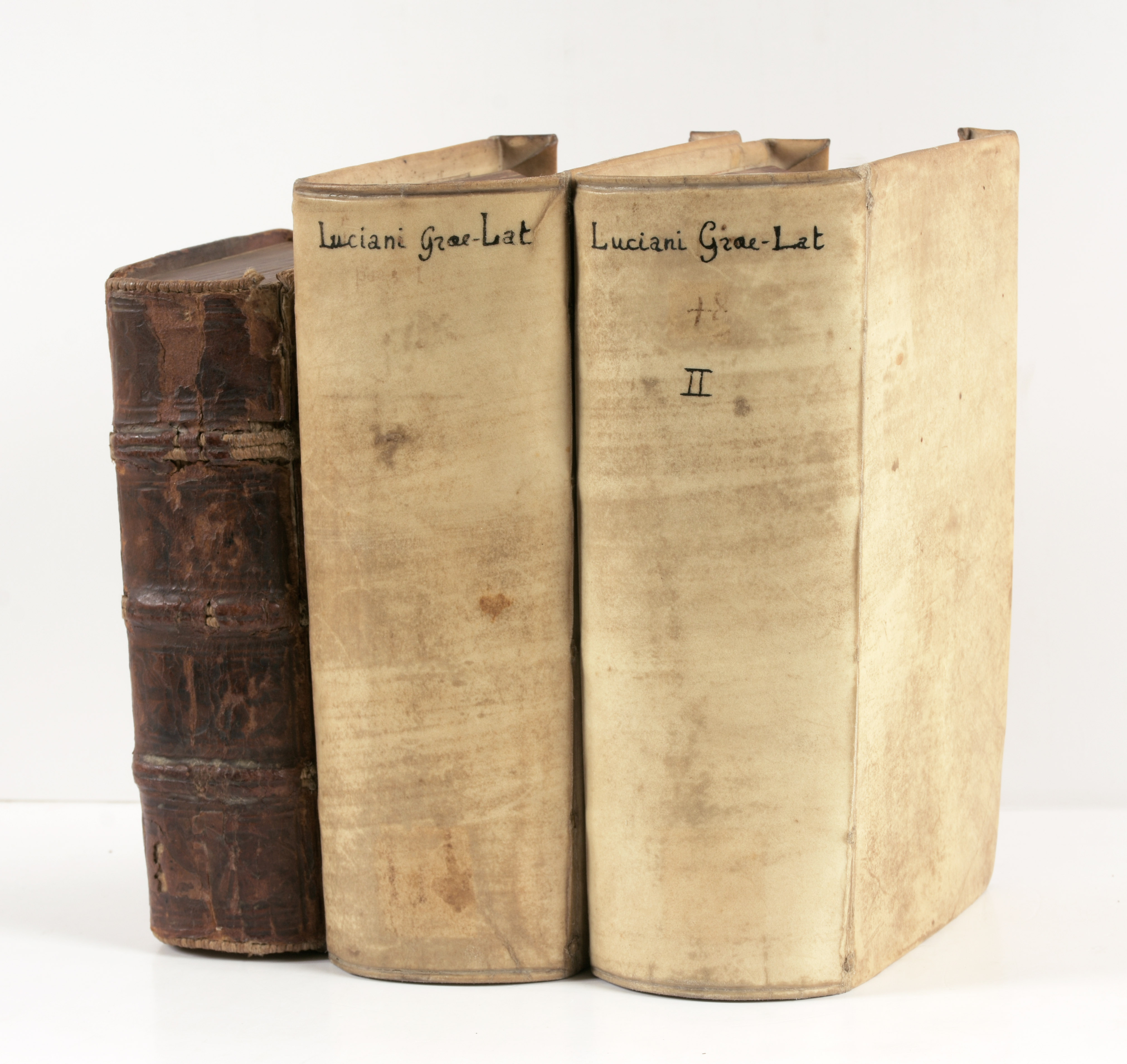
8vo: [2 (of 4)]-848 [= 843]-[1 bl.] pp. Entirely printed in Greek. Capital spaces with guide-letters. (missing title and beginning of Index; some toning, spotting and staining). Old blind-decorated leather, covers with roll-stamps and frames, spine with 3 raised bands (rubbed, spine dam.). Good copy. Volume I (of II) of one of the first complete editions of Lucian. Ref. VD16 L-2920. - Adams L-1606. Prov. A few old interlinear annotations. Old ownership entry on front flyleaf (deleted). We add: idem. Loukianou Hapanta [Greek] = Opera omnia in duos tomos divisa. Joh. Benedictus ex antiquis libris (...) emend. et Lat. versionem ita recogn. (...). Saumur, P. Piededius, 1619. 2 vol. in-8vo, parallel text in Greek and Latin, edited by Joannes Benedictus, who was doctor of medecine and professor of Greek at the Academy of Saumur. At the end of vol. 1 a chapter by ERASMUS: Declamatio D. Erasmi Roterodami, Luciani Tyrannicidae respondens. Library stamps on fly-lvs. Contemporary vellum bindings, red edges (together: 3 vol.)
Lucian's most famous work is "A True Story", a tongue-in-cheek satire against authors who tell incredible tales (like Homer and Thucydides), which is regarded by some as the earliest known work of science fiction (describing life on the Moon). Lucian had an enormous, wide-ranging impact on Western literature. Works inspired by his writings include Thomas More's Utopia, the works of François Rabelais, William Shakespeare's Timon of Athens and Jonathan Swift's Gulliver's Travels. (Wikipedia) "One who possesses an ironic temper will derive the most pleasure from Lucian. Erasmus was such a man, and it is this fact that accounts for this fondness for Lucian. He was the paramount Lucianist of the Renaissance. There were other Lucianists in his time, to be sure, but there was non greater, and non more generally praised and condemned for being such, than he." Ref. Thompson, The Translations of Lucian by Erasmus and S. Thomas More in : Revue belge de Philologie et d'Histoire, 1939