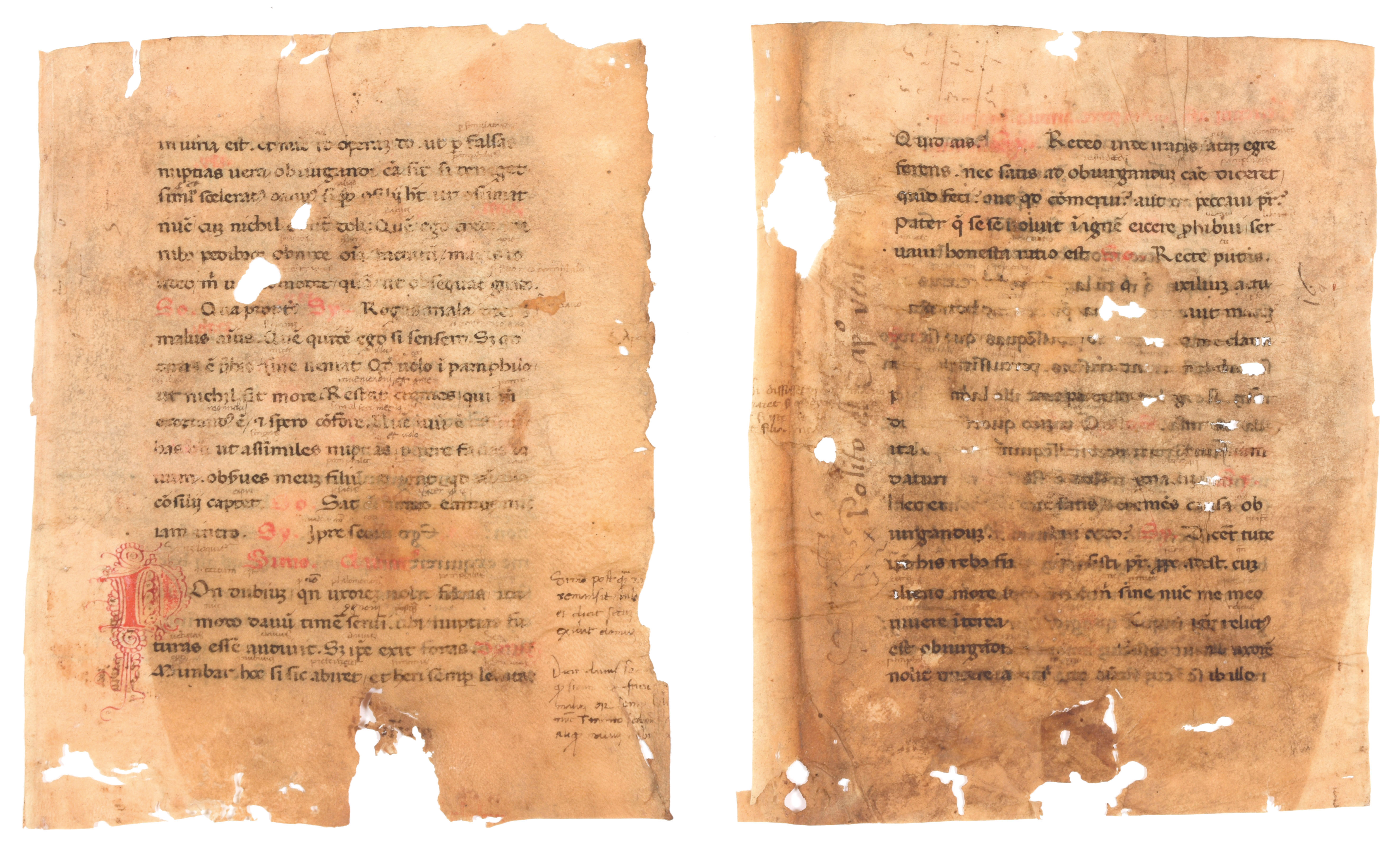
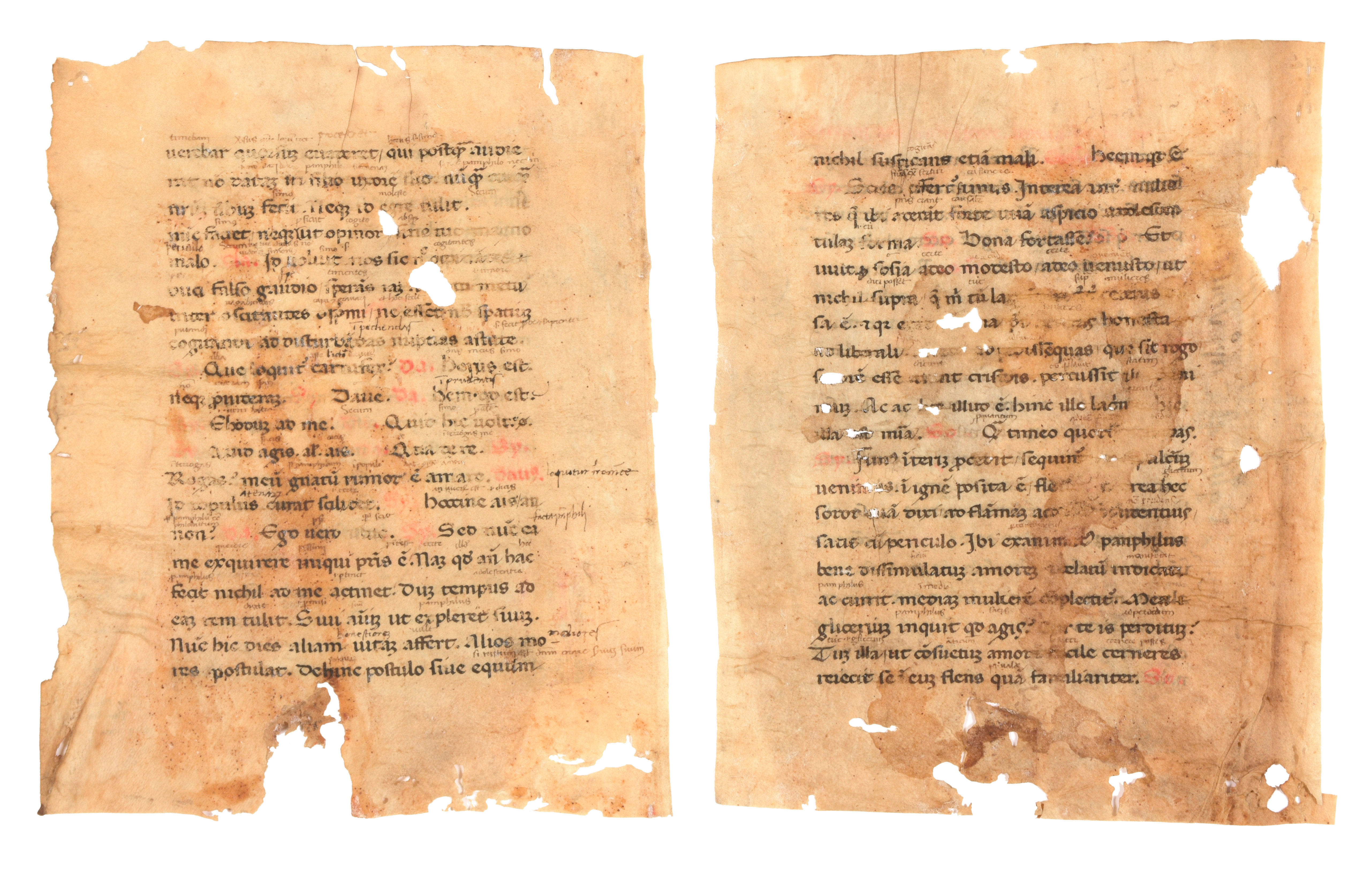
Two adjoining single leaves (with continuous text), each with text in single column of 20 lines of a semi-humanist hand, rubrics in red (these introducing dramatic speakers), remains of one large red initial 'N' (opening ""Non dubium quin uxorem ..."", the opening of Act I of the text) enclosed in looping red penwork, some contemporary and near-contemporary marginal and interlinear additions, as well as later scrawls from reuse as binding material on a later volume, reuse in later binding leading to scuffs, small holes, tears and stains (with water staining obscuring some of text on both leaves), but much of text still legible and overall in fair condition, each leaf approximately 180 by 140mm
Terence (more properly Publius Terentius Afer, c.?195/185-c.?159 BC.), was a Carthaginian slave brought to Rome as a youth, where he gained an education and his freedom, before setting off on a voyage to the Eastern Empire to seek literary inspiration. Six of his comedic plays survive, all based on Greek originals by Menander or Apollodorus of Carystus, and all composed in the period between 166 and 160 BC. The work here, Andria ('the girl from Andros'), concerns Pamphilus of Athens who falls in love with Glycerium, a foreign girl of low class, who has become pregnant by him, and plays out the drama ensuing from the wishes of Simo (Pamphilus's father) that his son should marry the daughter of his friend instead, and the schemes of the wily slave, Davus, to avoid this union. The play was first performed in 166 BC. during the Ludi Megalenses festival, probably on the steps of the temple of the Magna Mater Idaea in Rome, and Horace speaks of packed houses for performances in his time. The Andria was the first of Terence's plays to be performed post-antiquity, in Florence in 1476, and was adapted by Machiavelli for his initial venture into playwriting. The text here is continuous across the two leaves, and is from Act I, line 116, ""... nichil suspicans etiam mali ..."" to 156, ""ea primum ab illo""; then after two skipped words (""animum advortenda""), line 156 ""... iniuriast. et nunc id operam ..."" to 190 ""... de hinc postulo sive aequomst [here 'equum'] ...